Platform · Retain · Review · Dispose · Evidence
Lifecycle & Evidence
Decide in advance how material is kept, reviewed and brought to an end, and be able to account for it.
Lifecycle & Evidence is the part of DocuPrivé designed for the end of a document's working life: keeping it for a period set by policy, looking again before anything ends, bringing it to a considered end, and keeping a proportionate record of each decision. While a hold applies, nothing is brought to an end. All of this is designed and not yet built.
Everything on this page is designed and not yet built.
Where this page sits in the lifecycle
- 01Request
- 02Receive
- 03Classify
- 04Control
- 05Use
- 06Retain
- 07Review
- 08Dispose
- 09Evidence
Hold applies across every stage
Responsibility does not end when a document is shared: it runs until a considered end, and Evidence is recorded along the way.
Designed, not yet built
Every step has someone who decides.
Select a step to see who decides and what happens. Switch the hold on to see what it changes.
Who decides at each step, and what a hold changes
Hold applies: material is not brought to an end, whatever stage it is in.
-
06Retain
Your policy, set by an accountable person
Material is kept for a period set by policy, not left by accident. You decide the policy; DocuPrivé is designed to apply it.
-
07Review
The person accountable for the work
Before anything ends, the right people can look again. Reviewing is a decision with an owner, not a default left behind.
-
08Dispose
An accountable person, never automation alone
When the time comes, material is brought to a considered end. "End" means what DocuPrivé controls: its own copy and its own access.
Not brought to an end while the hold applies.
Evidence, 09 A proportionate record of what was decided, kept with privacy in mind, from the first Request to the end.
What a record does not prove.
A record shows an event happened in DocuPrivé. It does not prove a person read or understood a document.
It does not prove understanding or agreement either. Even an "opened" event needs care: some email security tools open links automatically to check them, before any person does.
DocuPrivé is designed to record what happened, plainly, and to say what each record can and cannot show.
Content and records, kept apart.
Document content and lifecycle records are designed to be kept separately, each with its own access and retention rules.
Automated assistance will not decide on its own to hold, keep or dispose of material. Those decisions have an accountable person.
Designed, not yet builtIn our development build
A first, narrow example today.
The Request record in our development build already keeps issue, identity verification, current access and email notification as separate entries. It is a first narrow example of recording what happened, not lifecycle evidence.
In our development build, Request record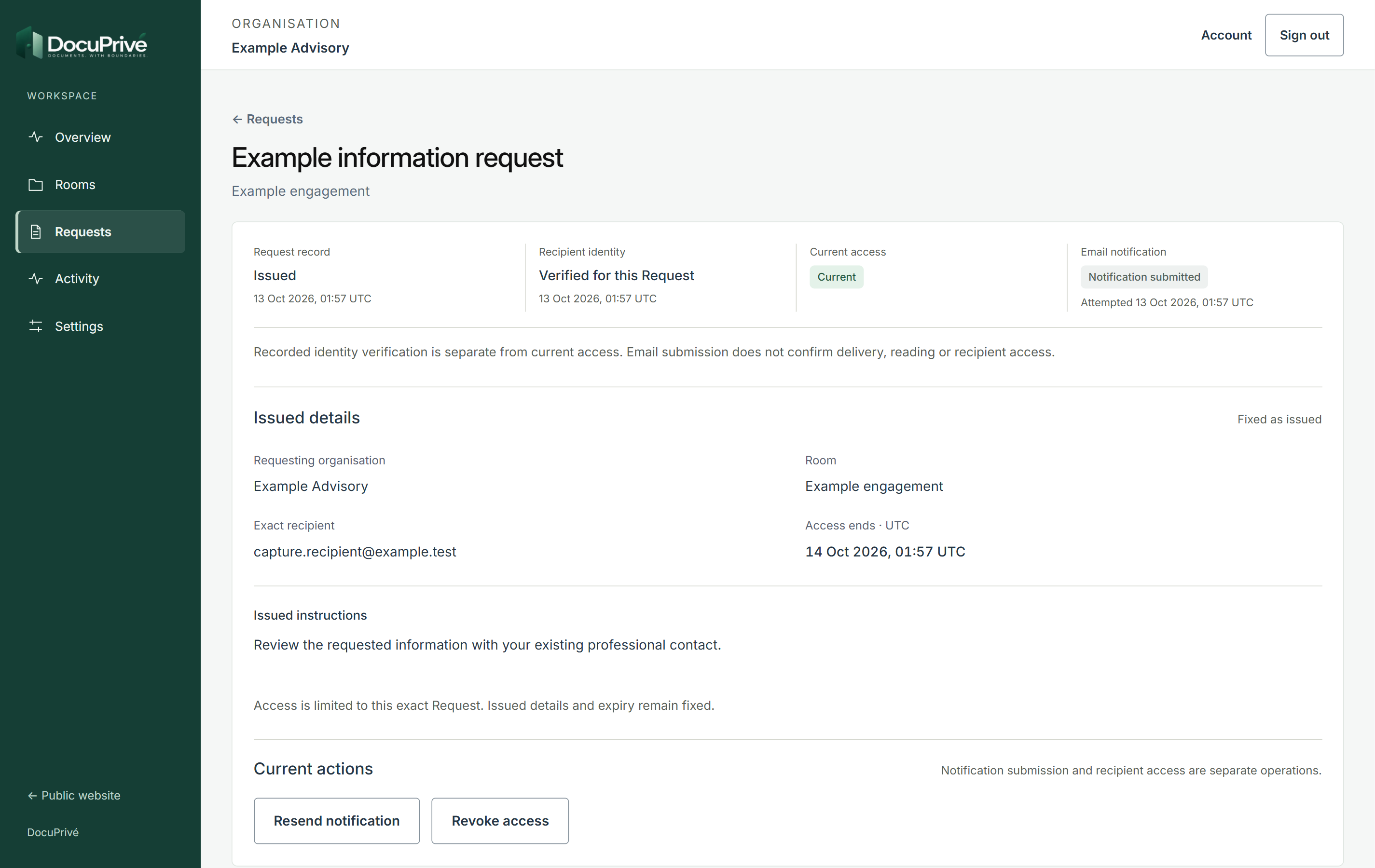
Questions
4 answers. More on the questions page.
Will DocuPrivé set retention periods for me?
No. Material is kept for a period set by your policy. DocuPrivé is designed to apply the policy you set, not to choose it for you.
What is a hold?
A hold is a control placed by an accountable person when circumstances require it, for example a dispute. While a hold applies, material is not brought to an end, whatever stage it is in. A hold is not a stage of its own.
Can a record prove that someone read a document?
No. A record shows that an event happened in DocuPrivé. It does not prove that a person read, understood or agreed with a document.
Does "dispose" mean deleted everywhere?
No. Disposal brings material held in DocuPrivé to a considered end. It cannot reach copies already downloaded or held in other systems.