Platform
One platform for the working life of a document.
DocuPrivé follows a professional document through nine stages: Request, Receive, Classify, Control, Use, Retain, Review, Dispose and Evidence. While a hold applies, nothing is brought to an end. Today's development build covers the first part, issuing a Request to one verified person for a defined period. The rest is designed and not yet built.
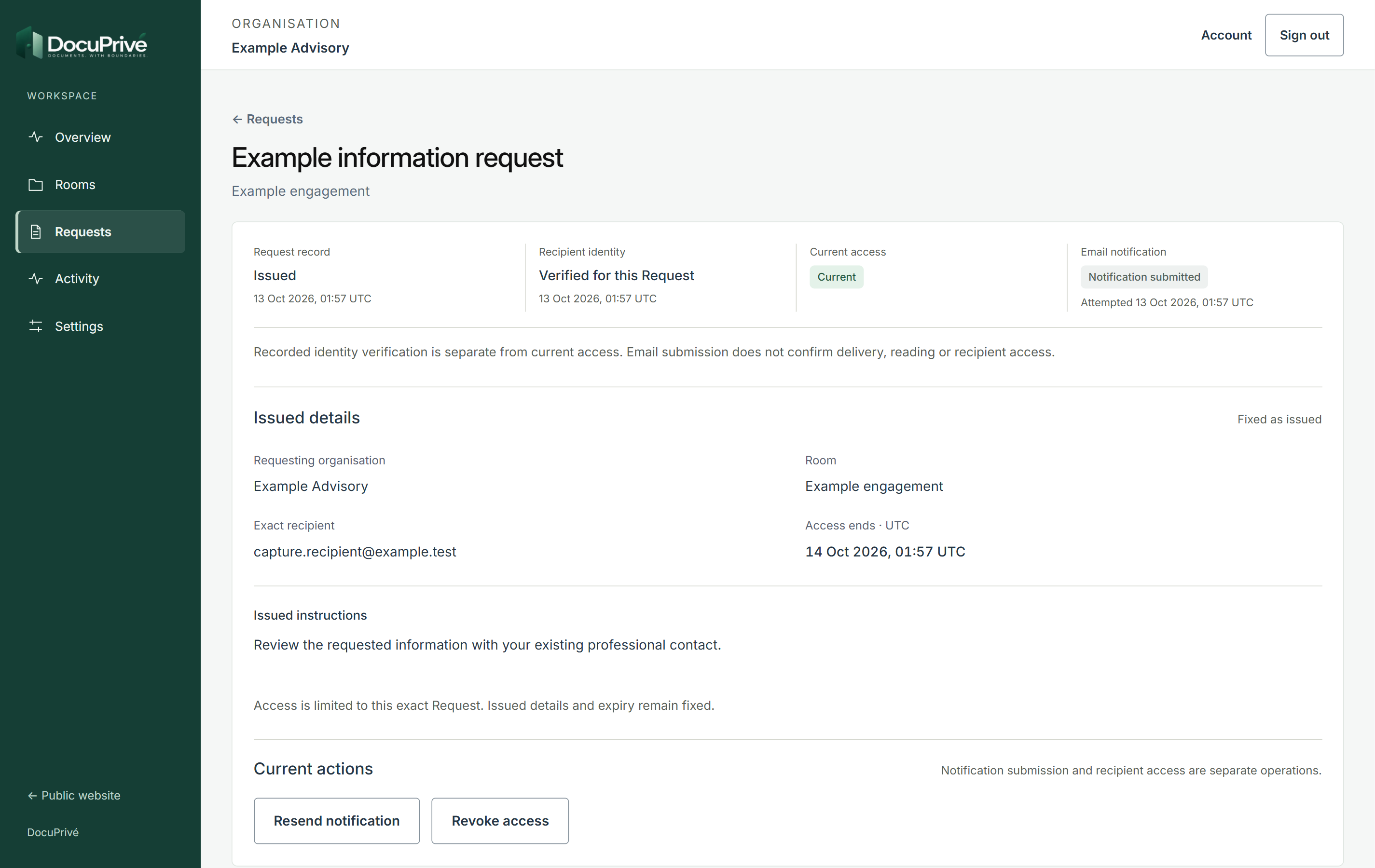
From the Request record in our development build: Once issued, the details are fixed. Issue, identity verification, current access and email notification are each recorded separately, and access can be revoked.
Four capabilities
Each one answers a different question about a document.
-
01 · Request · Receive · Classify
Request & Receive
Ask for exactly what the work needs, from one named person, with instructions and a fixed end to access. Documents are designed to arrive in the context of the Request they answer.
- Issued from inside a Room
- Details fixed once issued
- Resend or revoke
- Request In our development build
- Receive, Classify Designed, not yet built
-
02 · Organizing and finding
Library & Search
Every document is designed to keep a stable identity, a readable name and a recorded date, wherever it sits. Finding material respects the same boundaries as access.
- Stable identity
- Folders place, they do not permit
- Suggestions never move anything alone
- Library & Search Designed, not yet built
-
03 · Control · Use
Share & Recall
Give the people you choose access to a defined task, for a defined period, and end it when the work ends. External recipients see only what they were asked for.
- One verified recipient
- Exact end to access
- Ending access is not un-sending
- Control In our development build, for Request details
- Use Designed, not yet built
-
04 · Retain · Review · Dispose · Evidence, with Hold
Lifecycle & Evidence
Keep material for a period set by policy, look again before anything ends, bring it to a considered close, and keep a proportionate record of the decisions.
- Policy-set retention
- Review with an owner
- Hold stops the end
- Retain, Review, Dispose, Evidence, Hold Designed, not yet built
The lifecycle
Nine stages, one control across them.
Select a stage to read its definition and where it stands. Classify is a stage of its own; Hold is not a tenth stage.
The nine stages, grouped by capability
Hold applies across every stage. While a hold applies, material is not brought to an end. A control, not a stage.
Library & Search keeps material in order and findable within its boundaries, at every stage.Library & Search
Evidence is the ninth stage, and records also arise throughout the earlier ones.
Request & Receive
- 01 Request
Issue a Request from inside a Room: a title, instructions, the one person it is for, and the exact date and time access ends.
In our development build- 02 Receive
Documents arrive in the context of the Request they answer, not a general inbox.
Designed, not yet built- 03 Classify
Material is recognized for what it is and how it should be handled.
Designed, not yet built
Share & Recall
- 04 Control
Request details stay with a verified recipient, for a defined access period.
In our development build, for Request details- 05 Use
People work with the documents a task needs, and no more.
Designed, not yet built
Lifecycle & Evidence
- 06 Retain
Material is kept for a period set by policy, not left by accident.
Designed, not yet built- 07 Review
Before anything ends, the right people can look again.
Designed, not yet built- 08 Dispose
When the time comes, material is brought to a considered end.
Designed, not yet built- 09 Evidence
A proportionate record of what was decided, kept with privacy in mind, from the first Request to the end.
Designed, not yet built
Across every stage
- Hold a control, not a stage
While a hold applies, material is not brought to an end, whatever stage it is in. A hold is placed when circumstances require it, for example a dispute, by an accountable person.
Designed, not yet built
Scope
Clear about what it is not.
- Not a general file drive. Documents belong to a piece of work, not to a folder that grows forever.
- Not a way to un-send. Ending access is real; copies already downloaded are outside any platform's reach. What recall can and cannot do
- Not a substitute for professional judgment. Keeping, holding and disposing of material are decisions with an accountable person; automated assistance will not make them alone.
- Not available yet. We are building it in stages and will say when each one is ready.
Two kinds of information, kept apart by design.
A document's content and the record of what happened to it are different things, needed by different people for different lengths of time.
Document content and lifecycle records are designed to be kept separately, each with its own access and retention rules.
Designed, not yet built